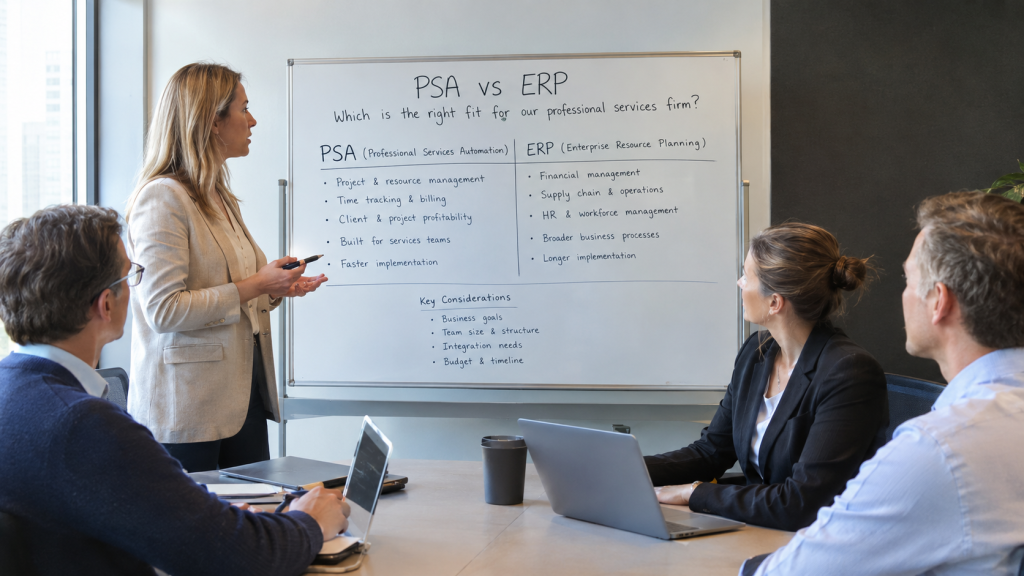
PSA vs ERP is a question of operating scope. Professional services automation software connects demand, staffing, project delivery, time, expenses, and project economics. ERP provides a backbone for integrating enterprise-wide processes and information used in day-to-day operations and planning.
Delivery blind spots usually point to PSA. Weak enterprise control points to ERP.
Many firms need both. The real decision is which system owns each record, which team controls each decision, and how data moves at the handoff. This guide helps executives choose PSA, ERP, or an integrated stack without stretching one platform beyond its strengths.
Key Takeaways: PSA vs ERP for Professional Services Firms
- PSA manages project delivery, resource planning, time, utilization, and project economics. ERP coordinates broader finance and enterprise processes.
- Choose PSA first when delivery visibility is weak, ERP first when financial control or multi-entity governance is weak, and an integrated stack when both gaps matter.
- Assign one system of record to each client, project, rate, invoice, and financial record, then decide whether the current stack can be configured or integrated before replacing it.
- EvolveUp’s professional services consulting helps firms evaluate PSA needs, define software requirements, and plan the route from selection through implementation.
PSA vs ERP at a Glance
PSA goes deeper into service delivery. ERP reaches across the enterprise.
A PSA connects demand, capacity, staffing plans, time, expenses, delivery risk, and project economics. An ERP coordinates finance and shared operating processes. The overlap is real, but it needs to be tested with your workflows.
| Decision factor | PSA | ERP |
|---|---|---|
| Primary purpose | Run project-based service delivery | Coordinate enterprise operations and finance |
| Core users | Delivery leaders, resource managers, project managers, consultants | Finance, procurement, payroll, operations, executives |
| Main records | Projects, assignments, skills, time, expenses, forecasts | Accounts, vendors, payments, entities, controls |
| Planning horizon | Near-term demand, capacity, staffing, delivery | Firm-wide budgets, controls, consolidation, long-range planning |
| Financial depth | Project budgets, margin visibility, billing inputs | General ledger, payables, receivables, statutory and entity reporting |
| Resource management | Detailed skills, availability, utilization, project demand | Broader workforce and cost planning, depending on scope |
| Billing role | Captures approved delivery data and billing triggers | Creates or governs invoices, accounting entries, and receivables |
| Integration role | Operational source for client-work data | Enterprise source for financial and shared-process data |
| Best fit | Firms with weak staffing, delivery, or project visibility | Firms needing broader financial control or multi-entity governance |
Product boundaries are messy. Some PSA platforms include project accounting, and some ERP platforms offer project or resource modules.
Labels alone won’t settle the choice. The best professional services automation software is the platform that supports the firm’s real workflows and connects cleanly to finance. Buyers need to validate the actual modules, decide who owns each data object, test the accounting workflow, and estimate the work required to connect the stack.
Evaluate cost across the whole stack. Licenses are only one line item.
Add implementation, migration, integrations, reporting tools, internal administration, support, training, and the effort required to keep duplicate processes alive. A lower-priced platform can cost more when people still rely on spreadsheets and manual reconciliations to run the business.
How PSA Supports Project-Based Service Delivery
Professional services automation software follows the economic life of client work. It connects pipeline demand to capacity, helps teams assign people by skill and availability, captures time and expenses, and turns delivery data into forecasts and billing inputs. For firms built on billable work, that level of detail matters because project margin can slip long before the general ledger shows why.
Ask these concrete questions.
- Who can start next month?
- Is a project consuming more hours than planned, and if so, why?
- Which skill will be short next quarter?
- Are approved milestones ready to bill?
Those answers need to be available at the engagement level, where delivery decisions happen. Otherwise, managers are guessing.
Growth makes the gaps harder to hide. A staffing decision that once fit into a weekly meeting gets messy when business units, geographies, and newly acquired teams use different definitions and planning cadences. Resource management software can create a shared operating view, but only after leaders agree on capacity, utilization, project health, and forecast confidence.
SPI Research’s 2026 PSA End-User Survey describes PSA as an operational system of record for project- and services-driven work. The report identifies the technology’s limits. Broad adoption, sound integration, clean data, and management commitment determine whether the platform becomes useful or turns into another reporting burden.
How ERP Supports Firm-Wide Financial and Operational Control
ERP software for professional services serves a broader purpose. The National Institute of Standards and Technology describes ERP as a backbone for integrating enterprise-wide processes and information.
The paper examines manufacturing rather than prescribing a services firm’s architecture. Its core point still holds. ERP coordinates day-to-day transactions and supports planning across connected functions.
For a services firm, that scope may include the general ledger, accounts payable and receivable, procurement, payroll, consolidated reporting, controls, and entity-level finance. ERP becomes more important when the business adds legal entities, geographies, complex purchasing, audit requirements, or reporting that must reconcile across the whole firm.
PE-backed firms feel this pressure quickly. An acquisition may bring another chart of accounts, payroll process, vendor base, and reporting cadence.
A firm-wide ERP can create common enterprise controls. The integration plan preserves the delivery detail that operators need to run client work.
Depth still matters. An ERP may show labor cost by entity yet lack the scheduling detail a resource manager needs.
Project accounting can exist without a usable view of skills, capacity, or delivery risk. Put real scenarios in the demo. The gaps show up fast.
What Should You Settle Before Comparing PSA and ERP Vendors?
Before comparing PSA and ERP vendors, settle which workflows, records, and handoffs each platform must own. EvolveUp’s professional services digital transformation work starts by assessing the current setup, defining software requirements, and building an implementation roadmap before selection. That sequence keeps the buying decision tied to how the firm operates.
PSA vs ERP: Four Differences That Change the Buying Decision
A source-of-truth exercise is more useful than a checklist of overlapping features. Follow one consulting engagement all the way from signed opportunity and initial staffing through delivery, invoicing, and final financial reporting. Name the owner and exception path at every step.
Core Workflows and Primary Users
PSA is built for the people who plan and deliver client work, including delivery leaders, resource managers, project managers, and consultants. ERP serves finance, procurement, payroll, operations, and executive users who need consistent controls across the business.
Different jobs. Different questions.
The same engagement looks different to each group. Delivery wants to know who can do the work and whether the project is on track.
Finance needs approved activity to become an invoice, a receivable, and a clean entry in the enterprise accounts. Map that first.
For a signed statement of work, PSA might create the demand, assignment, approved time, and billing milestone. ERP then receives and records the invoice. When both systems can edit a client, project, rate, or invoice, name the owner and lock down the handoff.
Resource Utilization and Enterprise Process Breadth
PSA usually goes deeper on skills, staffing, availability, capacity, utilization, and project demand. ERP spans more functions, but its service-delivery detail can be thin. That breadth can still leave resource managers making critical scheduling calls in a spreadsheet because the operational detail is missing.
The reverse is just as serious. A deep delivery system cannot stand in for enterprise finance, procurement, payroll, or formal controls.
During demos, test a real scheduling conflict, a demand forecast, and a management report that crosses functions. Watch where the workflow breaks.
Leaders need one definition of utilization. Decide which hours count, how leave and internal work are treated, and whether targets vary by role.
Software can calculate the metric. It won’t settle an operating-policy disagreement that leadership has avoided.
Project Economics, Billing, and Financial Authority
Project accounting software within a PSA can connect project budgets, time, expenses, work in progress, milestones, and margin visibility at the engagement level, giving delivery leaders an earlier view of slippage. Those records may supply approved billing and revenue inputs.
ERP usually holds final authority over invoices, receivables, the general ledger, and formal financial reporting. That boundary should be explicit.
Revenue processes make the boundary especially important. Under FASB’s Topic 606, companies identify contracts and performance obligations, then apply accounting judgment to complex arrangements.
A PSA can organize contract and delivery facts. It cannot make the accounting judgments required for compliant revenue recognition, especially in complex arrangements.
Draw the handoff before building it. Mark where approved time, expenses, milestones, invoice details, revenue schedules, and journal entries begin.
Then define exception review and reconciliation. Without a control point, two teams can produce defensible reports that still disagree.
Deployment Scope, Integration, and Governance
A cloud-based PSA implementation can stay relatively focused. Its scope may cover service operations, resource planning, time capture, project reporting, and the connections those teams rely on every day.
ERP work usually reaches further into finance, procurement, payroll, security, legal entities, and executive reporting. Vague ownership sinks both.
GAO’s 2026 systems migration review examines a federal financial system, but the lessons travel. Its guardrails cover strategic alignment, measurable outcomes, data cleansing, issue tracking, change management, user acceptance testing, and migration monitoring, a useful checklist for any enterprise rollout. Before configuration starts, define the master data, handoffs, update frequency, error ownership, controls, and reconciliation process.
Integration has to be run as an operating process. The API is only the plumbing.
Name the owner before go-live, especially when teams or implementation partners split responsibility. When PSA and ERP changes affect workforce systems and ways of working, an HR digital transformation plan should coordinate platform, process, training, and adoption.
When to Choose PSA, ERP, or Both
Start with the constraint holding the firm back today, then check it against the operating model you expect over the next three to five years. ERP for the professional services industry becomes the stronger first move when finance, procurement, controls, or consolidation is the binding constraint. A growing consultancy that can’t forecast capacity has a different starting point from a multi-entity firm that can’t produce reliable consolidated reporting.
| Decision point | PSA first | ERP first | Integrated stack |
|---|---|---|---|
| Best signal | Staffing, utilization, delivery, or project visibility is weak | Finance, procurement, controls, or consolidation is weak | Both delivery depth and enterprise governance are required |
| Capability gap | No reliable view of demand, capacity, or project economics | No consistent enterprise financial source of truth | Handoffs and ownership between operational and financial data are unclear |
| Likely owner | Services operations or delivery leadership | Finance or enterprise operations | Joint executive ownership across delivery, finance, and technology |
| Common risk | Expecting PSA to replace enterprise controls | Accepting shallow service-delivery workflows | Duplicated records, unclear authority, and brittle integrations |
Existing systems shape the answer. A firm may add PSA around a sound finance platform, extend an ERP after its project modules pass real workflow tests, or replace overlapping tools after a requirements and data-flow assessment.
Build a PSA software selection strategy around the operating need.
Don’t let the current system dictate the future decision. A big-bang replacement can create avoidable risk across data, integrations, reporting, project delivery, and the team’s daily work.
Preserving every legacy boundary can lock in the same problems. Sequence the roadmap around the highest-value constraint and the dependencies that must be resolved first.
Can Your Current Stack Stay?
A current platform can stay when its configuration and integrations meet the operating need without creating another source of truth. EvolveUp applies a vendor-agnostic HCM assessment to platforms, data flows, integration gaps, and manual work before recommending replacement. If better configuration can solve the problem, the roadmap should say so.
How to Evaluate and Implement the Right Stack
Map the current workflow from opportunity through cash collection. Capture every system, spreadsheet, handoff, approval, and manual reconciliation.
Next, define decision criteria, assign systems of record, score integration and reporting needs, and validate the design with real business scenarios. Test the messy cases before a vendor presentation makes everything look easy. A documented HR technology roadmap can keep system sequencing, ownership, and adoption decisions visible when PSA or ERP touches the workforce stack.
Use these questions to ground the evaluation in operating reality.
- Where does each critical data object originate?
- Can the system forecast resources and project economics at the level leaders actually manage?
- How will approved time, expenses, milestones, invoices, revenue schedules, and journal entries move between systems and reconcile at period end?
- Which multi-entity, security, audit, API, and reporting requirements are nonnegotiable?
- What will migration, integration, licenses, support, administration, and change adoption cost over time?
Implementation needs the same discipline. Protect subject-matter-expert time, clean data before migration, test in phases, train by role, and measure adoption after go-live.
PSA implementation needs an accountable executive owner, followed by post-launch optimization. Technically working software still fails when teams retreat to old spreadsheets and side processes.
Software alone won’t improve utilization, margin, cash flow, or ROI. PE-backed firms preparing for growth, acquisition, or exit need an operating model and adoption plan that makes those limits explicit.
Before EvolveUp recommends a platform, the team maps the workflows, ownership decisions, data, and business outcomes that the operating model depends on.
A useful roadmap names decision owners, phased scope, migration waves, test scenarios, cutover criteria, adoption measures, and post-go-live governance. Just as important, it states which systems, processes, and integrations will stay out of the first phase. Clear boundaries keep a targeted implementation from turning into an uncontrolled enterprise redesign.
Build the Stack Around How Your Firm Earns Revenue
PSA manages how client work is planned and delivered. ERP governs enterprise operations and finance.
Many professional services firms need a deliberate connection between them, with clear ownership for every record and reconciliation point. That connection, along with the ownership rules behind it, becomes the architecture.
Choosing between PSA and ERP gets expensive when ownership, data, and handoffs remain unsettled. EvolveUp’s HR technology consulting team maps those decisions before selection, then turns them into a practical roadmap for integrations, migration, testing, training, and adoption. If your firm needs delivery depth and enterprise control, schedule a consultation to pressure-test the stack before you commit.