
HR has spent the last two years absorbing two shocks at once, a fast move into AI-powered tools and a workforce that is less engaged than it has been in a decade. The latest HR statistics make both concrete. The data covers six areas. AI adoption in HR. The gap between adoption and real value. Employee engagement and what it costs. Where and how people work. The skills shift. And the HR labor market itself.
Below are 26 HR statistics for 2026. Every number comes from primary research by SHRM, McKinsey, Gallup, Pew Research Center, the World Economic Forum, and the U.S. Bureau of Labor Statistics. Every stat is cited inline. Full source details are at the bottom of the page.
AI in HR Statistics
These HR AI statistics cover how fast the function is adopting AI and how unevenly that adoption is maturing.
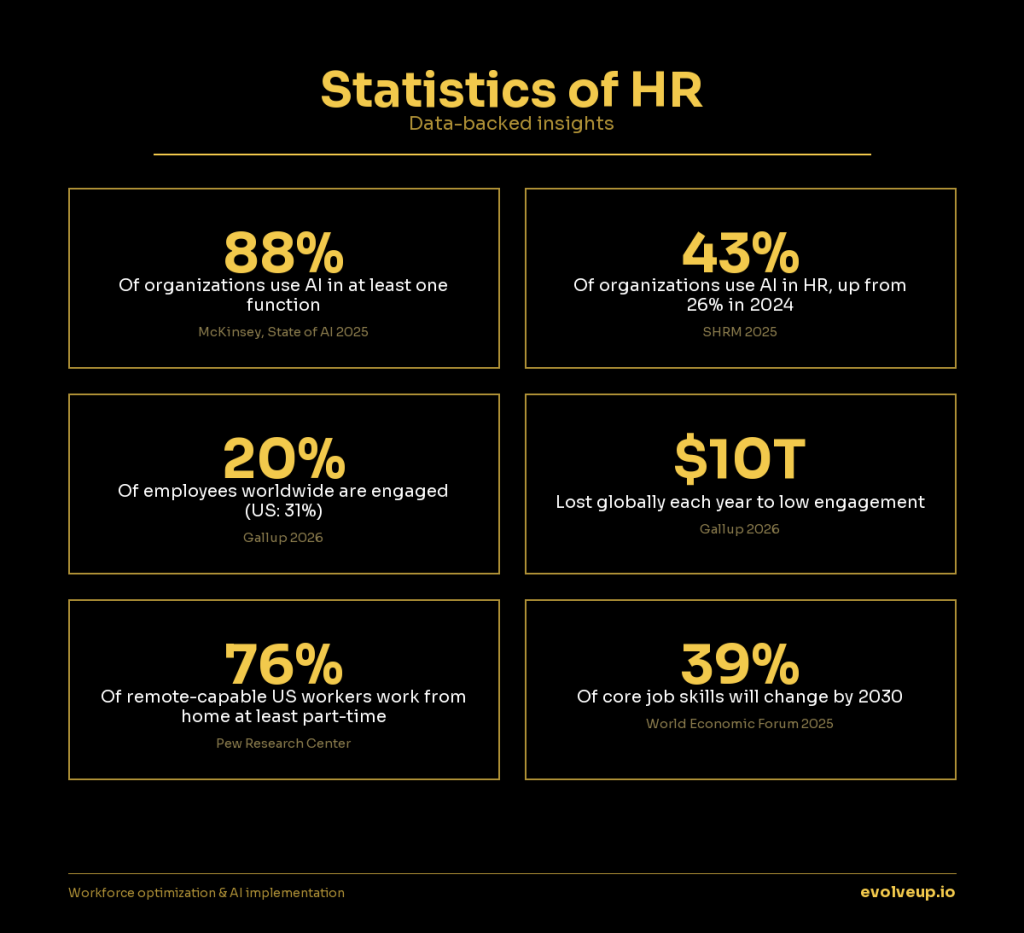
43% of organizations applied AI to HR tasks in 2025, up from 26% in 2024 [1].
46% of organizations expect to use AI in HR through 2026 [1].
About 60% of organizations with 5,000 or more employees have put AI to work in HR, compared with roughly 33% of small firms [1].
88% of organizations now use AI in at least one business function, up about 10 points year over year [2].
71% of organizations say they regularly use generative AI [2].
Only about 7% of organizations have fully scaled AI across the enterprise [2].
67% of organizations disagree that their company proactively trains staff to use AI [1]. That training gap is usually what stalls a rollout, which is why HR technology implementation succeeds or fails on adoption, not on the platform.
AI Value Gap Statistics
Adoption is near universal, but the return on it is rare. These numbers show the gap.
60% of executives use AI in decision-making, yet only 5% say they manage it well [3].
Just 6% of leaders say they are making real progress on designing how people and AI work together [3]. A practical workforce optimization effort typically reclaims about 25% of employee time, which is the difference between an AI line item and an AI result.
Employee Engagement Statistics
Engagement is the clearest pressure point in the 2026 HR data, and the cost of getting it wrong is measurable.
Only 20% of employees worldwide are engaged at work [4].
In the U.S., engagement sits at 31%, a decade low [4].
Low engagement drains roughly $10 trillion from the global economy each year, equal to about 9% of GDP [4].
About 70% of the variance in team engagement traces back to the manager [4].
Manager engagement has fallen to 22% globally, lower than the employees they lead [4]. That points HR investment toward manager enablement and the kind of retention work that keeps experienced people in their seats.
Remote and Hybrid Work Statistics
The location debate has settled into a durable hybrid pattern.
Among U.S. workers whose jobs can be done from home, 35% work from home all the time [5].
Another 41% are on a hybrid schedule, so roughly three-quarters of remote-capable workers are home at least part of the week [5].
46% of those who currently work from home at least sometimes say they would be unlikely to stay in their job if remote work were taken away [6].
Skills and Workforce Change Statistics
Skills change is the trend most likely to define HR planning through the rest of the decade.
39% of workers’ core skills are expected to change by 2030, down from 44% in the prior report, which suggests the pace of disruption is steadying rather than accelerating [7].
170 million new roles are projected to be created and 92 million displaced by 2030, a net gain of 78 million jobs [7].
The labor market faces about 22% churn over that period [7].
66% of managers say their recent hires are unprepared for the work [3], a sign that hiring alone will not close a shift this size and that workforce transformation has to build in reskilling and redeployment.
HR Labor Market Statistics
It is easy to write about HR’s effect on the workforce and skip HR as a workforce.
The median annual wage for U.S. human resources specialists was $72,910 as of May 2024 [8].
Human resources specialists held roughly 944,300 jobs in the U.S. [8].
The quits rate settled near 2.0% in 2025, well below the 2021 and 2022 highs, a sign of a cooler market that shifts the advantage back toward employers who can move quickly [9].
Taken together, these HR statistics describe a function under pressure on two fronts at once, racing to make AI pay off while holding on to the people and the engagement that actually drive results. The organizations that come out ahead in 2026 will treat both as operational problems to solve rather than headlines to react to.
Sources
- SHRM. “The State of AI in HR 2026.” SHRM, 2026, https://www.shrm.org/topics-tools/research/state-of-ai-hr-2026/full-report.
- McKinsey & Company. “The State of AI in 2025.” McKinsey & Company, 2025, https://www.mckinsey.com/capabilities/quantumblack/our-insights/the-state-of-ai.
- Deloitte. “2026 Global Human Capital Trends.” Deloitte, 2026, https://www.deloitte.com/us/en/about/press-room/deloitte-report-winning-organizations-will-build-the-human-advantage.html.
- Gallup. “State of the Global Workplace 2026.” Gallup, 2026, https://www.gallup.com/workplace/349484/state-of-the-global-workplace.aspx.
- Pew Research Center. “About a Third of U.S. Workers Who Can Work From Home Now Do So All the Time.” Pew Research Center, 30 Mar. 2023, https://www.pewresearch.org/short-reads/2023/03/30/about-a-third-of-us-workers-who-can-work-from-home-do-so-all-the-time/.
- Pew Research Center. “Many Remote Workers Say They’d Be Likely to Leave Their Job If They Could No Longer Work From Home.” Pew Research Center, 13 Jan. 2025, https://www.pewresearch.org/short-reads/2025/01/13/many-remote-workers-say-theyd-be-likely-to-leave-their-job-if-they-could-no-longer-work-from-home/.
- World Economic Forum. “The Future of Jobs Report 2025.” World Economic Forum, 2025, https://www.weforum.org/publications/the-future-of-jobs-report-2025/.
- U.S. Bureau of Labor Statistics. “Occupational Employment and Wage Statistics, Human Resources Specialists.” U.S. Department of Labor, May 2024, https://www.bls.gov/oes/current/oes131071.htm.
- U.S. Bureau of Labor Statistics. “Job Openings and Labor Turnover Summary.” U.S. Department of Labor, 2026, https://www.bls.gov/news.release/jolts.nr0.htm.