HR is in the middle of its biggest shift in a generation. AI has moved out of pilot mode and into day-to-day operations. Talent is harder to find, the skills companies need keep changing, and CHROs are being asked to deliver measurable performance gains while their own teams reshape around them. These HR transformation trends capture where the work stands.
What follows is more than 40 cited statistics across eight categories. Those categories are AI adoption inside HR, the skills gap and reskilling, HR technology spending, employee engagement and burnout, talent acquisition, leadership and change management, AI governance and worker sentiment, and the HR career outlook. Every figure links back to its original source so you can verify or cite it directly.
AI Adoption Inside the HR Function
Every major HR transformation now hinges on AI adoption, and AI use inside HR has scaled faster than almost any other corporate function. The 2026 numbers show how quickly the technology has moved from experimentation into everyday work.
39% of organizations currently have AI adopted in HR functions, and another 7% intend to launch HR AI initiatives within the year, according to SHRM‘s State of AI in HR 2026 report [1]. Total AI use across all departments climbs to 62% of organizations, and SHRM projects that 46% of organizations will be using AI in HR by 2026 [1].
Adoption is heavily concentrated among larger employers. 60% of extra-large organizations have implemented AI in HR, compared with 35% of midsize organizations and 33% of small organizations [1].
Inside organizations that have rolled out AI, 26% of HR professionals use AI tools weekly, 20% use them daily, and 9% use them several times a day [1]. Adoption tracks closely with seniority. 73% of HR professionals at the director level and above had adopted AI by 2025, compared with 66% of managers and 65% of individual contributors [1].
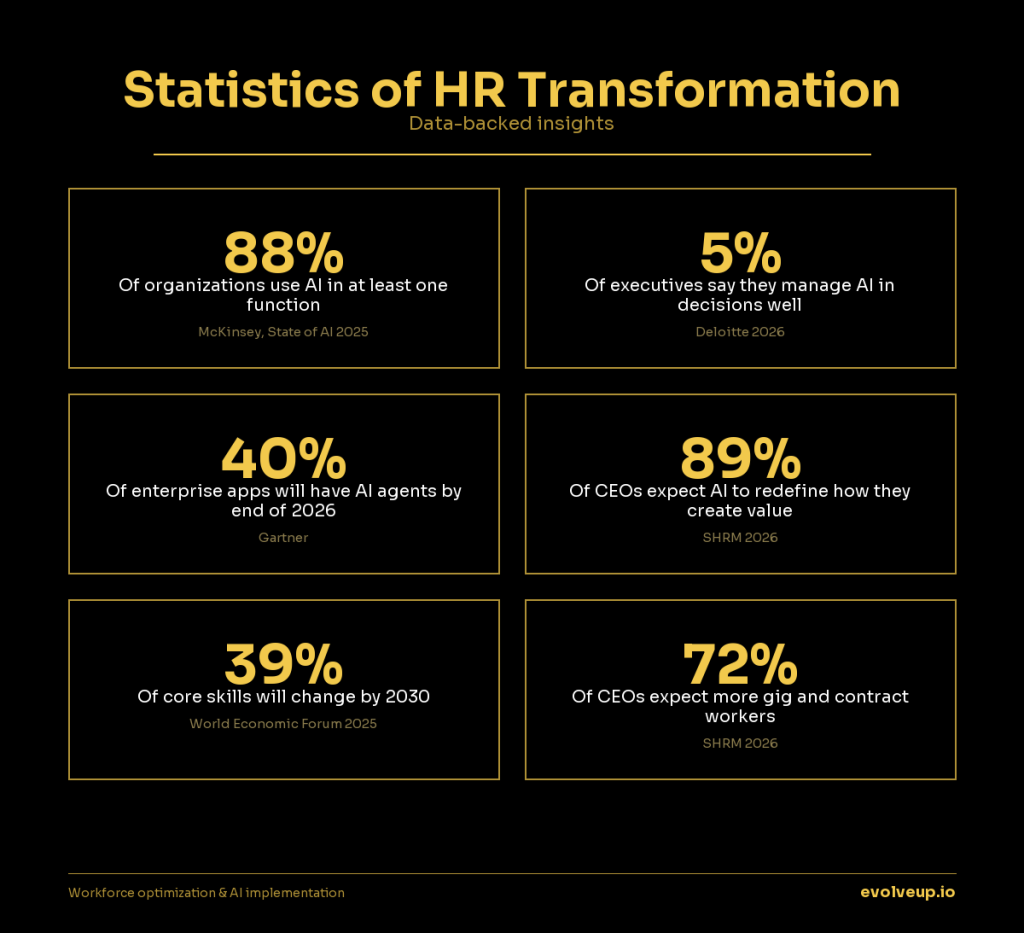
Across the broader enterprise, 88% of respondents in McKinsey’s State of AI in 2025 reported regular AI use in at least one business function, up from 78% the year prior [2]. 23% have begun scaling an agentic AI system somewhere in their enterprise, and 39% are experimenting with AI agents [2].
The Skills Gap and Workforce Reskilling
The mismatch between the skills companies have and the skills they need is now the dominant constraint on HR strategy, and continuous learning and reskilling have become the primary response.
22% of jobs globally are expected to be disrupted by 2030, with 170 million new roles created and 92 million displaced, producing a net gain of 78 million jobs, according to the World Economic Forum’s Future of Jobs Report 2025 based on responses from more than 1,000 employers representing 14 million workers across 55 economies [3].
Nearly 40% of the skills required for current jobs will change between now and 2030, and 63% of employers already cite skills gaps as the single biggest barrier to business transformation [3]. The WEF estimates that 59 out of every 100 workers will require training by 2030 [3].
Mercer’s Global Talent Trends 2026, based on a survey of nearly 12,000 executives, HR leaders, investors, and employees, found that 65% of executives expect 11% to 30% of their workforce to be redeployed or reskilled because of AI [4]. 63% of executives say they need skills-powered talent practices, and 59% of HR leaders report difficulty attracting talent with the digital skills they need [4].
Employees are aware of the same gap. 53% are worried about lacking future-ready skills, and 63% say they would trade a 10% pay raise for AI and digital upskilling opportunities [4].
The resource gap behind these numbers is uneven. Only 51% of non-managers feel they have the learning and development resources they need, compared with 66% of managers and 72% of senior executives, according to PwC’s 2025 Global Workforce Hopes and Fears Survey of nearly 50,000 workers [5].
HR Technology Spending and Strategic Priorities
HR tech budgets are still expanding. The focus of HR technology consulting, though, is shifting from buying new systems to changing how the function operates.
Deloitte’s 2026 Global Human Capital Trends Report, drawn from a survey of more than 9,000 business and HR leaders across 89 countries, found that seven in 10 business leaders rank speed and agility as their primary competitive strategy over the next three years [6]. 59% of organizations take a tech-focused approach to AI implementation, but those organizations are 1.6 times more likely to fail to exceed investment-return expectations than peers taking a human-centric approach [6].
Gartner’s research on 426 CHROs across 23 industries and four global regions found that evolving the HR operating model could deliver up to 29% in productivity gains [7]. The same research identified Leader and Manager Development as the top HR priority for the second consecutive year, with culture in second place and change management and workforce resiliency climbing to third [7].
Employee Engagement and Burnout
Employee engagement has gotten worse even as transformation has sped up. That’s putting real strain on the workforce, and HR teams are the ones being asked to handle it.
Only 20% of employees worldwide were engaged in 2025, the lowest level since 2020, according to Gallup’s State of the Global Workplace report [8]. Disengagement costs the global economy an estimated $10 trillion in lost productivity, and Gallup calculates that full engagement would add $9.6 trillion to global GDP, the equivalent of 9% of world output [8].
Manager engagement fell from 27% to 22% between 2024 and 2025, the largest year-over-year drop on record [8]. The contrast inside best-practice organizations is stark. 79% of managers in those companies are engaged at work, nearly four times the global average [8].
Wellbeing has tracked the same direction. The share of global employees who rate themselves as thriving fell to 33% in 2024 [8]. Mercer reports an even sharper drop in workplace-specific thriving, from 66% in 2024 to 44% in 2026, lower than during the COVID-19 pandemic [4]. 22% of employees globally feel lonely “a lot of the previous day,” and that figure rises to 23% among remote workers [8].
Talent Acquisition and Recruitment Trends
Recruiting is the busiest application of AI in HR today, and the tooling is already reshaping budgets and headcount plans.
Recruiting accounts for the largest single share of HR AI deployments, with 27% of organizations using AI in talent acquisition [1]. 66% of AI-adopting organizations apply it to job descriptions and 44% use it for resume screening [1]. Talent acquisition professionals who use generative AI report a 20% workload reduction, though only 37% actively integrate it into their workflows [9].
According to Gartner research cited in SHRM’s coverage, 82% of HR leaders plan to implement agentic AI within their functions by May 2026 [9]. At the same time, only 30% of companies expect their talent acquisition budgets to grow in 2026, and 24% plan to add recruiter headcount [9].
Demand for talent remains high. 54% of C-suite leaders rank talent scarcity as the top force influencing their people plans, according to Mercer [4].
Leadership and Change Management
Leaders and culture sit on the behavioral side of workforce transformation. That’s where most CHROs say their biggest gains and losses now show up.
Gartner found that organizations that successfully embed their desired culture into employees’ daily work see up to a 34% increase in employee performance [7]. When change is treated as an instinctive part of work rather than an extraordinary demand, organizations are three times more likely to achieve healthy change adoption [7]. A July 2025 Gartner survey of 222 CHROs found that only 47% believe their culture currently drives employee performance [7].
Mercer’s research shows confidence has slipped at the top. 51% of C-suite leaders say they are confident their organization is prepared for the AI era, down from 65% in 2024 [4]. 83% of investors say adaptable leaders outperform during disruption, and 82% of C-suite leaders now see the future HR function as one that manages humans and digital agents together [4]. 98% of executives are planning organizational design changes within the next two years [4].
AI Governance, Worker Sentiment, and Risk
Trust, regulation, and worker impact are the next set of issues HR leaders have to manage as deployments scale.
87% of HR professionals using AI report improved work efficiency, 75% report improved work quality, and 77% say AI has had no impact on their job security [1]. PwC found that 92% of daily generative AI users report improved productivity, and 52% have seen salary increases [5]. Use is climbing fast. 57% of workers now use generative AI weekly or more often, up from 26% in 2024 [5].
The sentiment is not uniformly positive. 40% of employees are concerned about losing their job to AI, up from 28% in 2024, according to Mercer [4]. 52% of workers worry about AI’s broader workplace impact, according to Pew Research cited by AIHR [10].
Governance is lagging adoption. 49% of organizations that use or are piloting AI have formal AI policies, but only 25% of those with policies feel they are clear and future-proof [1]. 57% of HR professionals working in U.S. states with workforce AI regulations are not aware of those regulations [1].
HR Workforce and Career Outlook
The work HR teams do is changing, and so is the size and shape of the function itself.
The U.S. Bureau of Labor Statistics projects 6% employment growth for human resources specialists from 2024 to 2034, faster than the average for all occupations, with approximately 81,800 openings projected each year over the decade. The median annual wage was $72,910 in May 2024 [11].
Employment of human resources managers is projected to grow 5% from 2024 to 2034, also faster than average, with about 17,900 openings projected per year. The median annual wage for HR managers was $140,030 in May 2024 [12].
Inside HR, the function and its underlying HR tech stack are being rebuilt around AI. Josh Bersin’s 2026 Imperatives report projects that AI evolving from assistants to agents and superagents could automate up to 100 core HR processes and shift 30% or more of traditional HR headcount toward higher-value work [13]. Bersin’s research also estimates that 60% to 70% of work currently performed by training and development teams can be automated [13], and separate Bersin research found that 74% of companies say they are not keeping up with their own demand for new skills [14].
Taken together, these HR transformation trends point to a function under rapid reinvention, with AI, skills, leadership, and governance all moving at once.
Sources
- [1] Society for Human Resource Management. “The State of AI in HR 2026: Full Report.” SHRM, Dec. 2025, https://www.shrm.org/topics-tools/research/state-of-ai-hr-2026/full-report.
- [2] Singla, Alex, et al. “The State of AI in 2025: Agents, Innovation, and Transformation.” McKinsey & Company, Nov. 2025, https://www.mckinsey.com/capabilities/quantumblack/our-insights/the-state-of-ai.
- [3] World Economic Forum. “Future of Jobs Report 2025: 78 Million New Job Opportunities by 2030 but Urgent Upskilling Needed to Prepare Workforces.” World Economic Forum, 7 Jan. 2025, https://www.weforum.org/press/2025/01/future-of-jobs-report-2025-78-million-new-job-opportunities-by-2030-but-urgent-upskilling-needed-to-prepare-workforces/.
- [4] Mercer. “Investors Say Companies Combining Human and AI Capabilities Gain a Competitive Advantage, According to Mercer’s Global Talent Trends 2026 Report.” Mercer Newsroom, 25 Feb. 2026, https://www.mercer.com/about/newsroom/mercer-s-global-talent-trends-2026-report/.
- [5] PwC. “Global Workforce Hopes and Fears Survey 2025.” PwC, 2025, https://www.pwc.com/gx/en/issues/workforce/hopes-and-fears.html.
- [6] Deloitte. “2026 Global Human Capital Trends.” Deloitte Insights, 4 Mar. 2026, https://www.deloitte.com/us/en/insights/topics/talent/human-capital-trends.html.
- [7] Gartner. “Gartner Says CHROs’ Top Priorities for 2026 Center Around Realizing AI Value and Driving Performance Amid Uncertainty.” Gartner Newsroom, 2 Oct. 2025, https://www.gartner.com/en/newsroom/press-releases/2025-10-02-gartner-says-chros-top-priorities-for-2026-center-around-realizing-ai-value-and-driving-performance-amid-uncertainty.
- [8] Gallup. “State of the Global Workplace: Employee Engagement Data and Trends.” Gallup, 2025, https://www.gallup.com/workplace/349484/state-of-the-global-workplace.aspx.
- [9] Society for Human Resource Management. “Precision Over Scale: The New Rules of Hiring in 2026.” SHRM, 2026, https://www.shrm.org/topics-tools/news/talent-acquisition/talent-acquisition-management-trends-2026.
- [10] van der Merwe, Marna, et al. “11 HR Trends for 2026: Shaping What’s Next.” AIHR, 2026, https://www.aihr.com/blog/hr-trends/.
- [11] U.S. Bureau of Labor Statistics. “Human Resources Specialists.” Occupational Outlook Handbook, U.S. Department of Labor, 2025, https://www.bls.gov/ooh/business-and-financial/human-resources-specialists.htm.
- [12] U.S. Bureau of Labor Statistics. “Human Resources Managers.” Occupational Outlook Handbook, U.S. Department of Labor, 2025, https://www.bls.gov/ooh/management/human-resources-managers.htm.
- [13] Bersin, Josh. “In 2026 AI-Powered Superagents Will Radically Change HR, Driving the Largest HR Transformation in Decades.” PR Newswire, 21 Jan. 2026, https://www.prnewswire.com/news-releases/in-2026-ai-powered-superagents-will-radically-change-hr-driving-the-largest-hr-transformation-in-decades-302666677.html.
- [14] Bersin, Josh. “AI Is Disrupting the $400 Billion Corporate Training Market at a Quickening Pace, Warns The Josh Bersin Company.” PR Newswire, 20 Feb. 2026, https://www.prnewswire.com/news-releases/ai-is-disrupting-the-400-billion-corporate-training-market-at-a-quickening-pace-warns-the-josh-bersin-company-302684945.html.