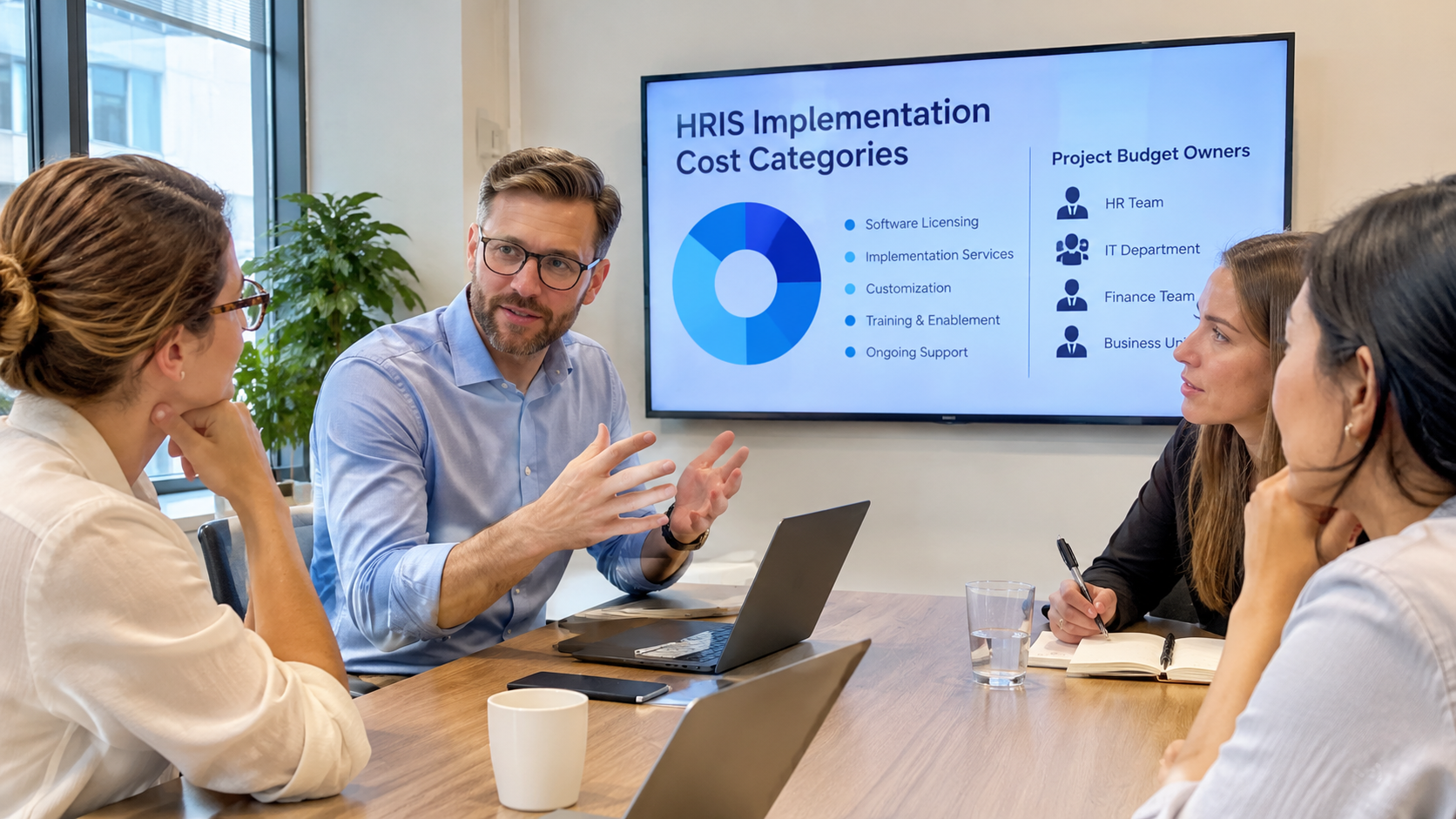
HRIS implementation cost includes the external delivery scope and the internal work needed to prepare data, configure processes, connect systems, test, train users, launch, and stabilize the platform. The quote is only one piece of the budget.
A universal HR software implementation cost estimate is useless until the scope is clear. A defensible budget separates one-time project work from recurring ownership, assigns every line to an owner, and records the assumptions behind each estimate.
Key Takeaways for an HRIS Implementation Budget
- HRIS implementation cost should cover external services, internal labor, data migration, integrations, testing, training, change adoption, go-live support, risk allowance, and post-launch ownership.
- Budget internal capacity and backfill alongside vendor fees because HR, payroll, IT, finance, security, managers, and user testers still own decisions and approvals.
- EvolveUp’s HR implementation services span readiness, platform selection, configuration, integration, migration, testing, training, change management, go-live, and optimization, which gives budgeting teams a delivery checklist for assigning cost owners.
- Unresolved data, integration, policy, or ownership questions should be priced as documented uncertainty, not hidden inside a generic contingency line.
What Should an HRIS Implementation Budget Include?
An HRIS implementation budget should include external implementation work plus internal labor, migration, integrations, testing, training, change adoption, go-live support, risk allowance, and post-launch ownership. Map those lines to the HRIS implementation process so each phase has a cost owner and a clear completion test.
| Budget category | Typical owner | Timing | Scope assumption | Evidence to request |
| External delivery | HRIS owner and partner lead | One-time | Modules, entities, locations, and partner scope | Itemized statement of work and acceptance criteria |
| Internal team and backfill | Executive sponsor and function leads | One-time | Protected hours by role and phase | Staffing plan, capacity assumptions, and approvals |
| Data migration | Data owners and migration lead | One-time | Sources, history, cleanup, mock loads, and reconciliation | Mapping, test results, exception log, and sign-off |
| Integrations and custom work | IT and integration lead | One-time plus support | Interfaces, fields, methods, monitoring, and ownership | Specifications, test evidence, support model, and exclusions |
| Testing, training, and adoption | Test lead and change lead | One-time plus reinforcement | Test cycles, audiences, materials, and employee time | Test results, training plan, and adoption measures |
| Go-live and hypercare | Program lead and support owner | One-time | Cutover, continuity, staffing, rollback, and exit criteria | Cutover plan, issue process, and transition approval |
| Ongoing ownership | HRIS product owner | Recurring | Administration, support, releases, audits, and enhancements | Operating model, service levels, and annual plan |
| Risk allowance | Sponsor and finance | One-time reserve | Named uncertainty in data, scope, timing, or capacity | Risk register, approval rule, and actual-cost updates |
Keep software licensing and quoted HRIS implementation fees visible, but separate both from the implementation subtotal. Treat the HRIS setup cost as one part of the budget, not the full HRIS total cost of ownership. That distinction lets finance compare proposals on the same basis.
Separate One-Time Implementation Costs From Recurring HRIS Costs
One-time costs cover the work required to design, build, test, and launch the HRIS. Typical lines include readiness, requirements, configuration, data conversion, interface development, testing, training, cutover, and initial support.
Recurring costs start once the platform goes live and day-to-day ownership begins. Subscriptions, premium support, administration, integration monitoring, audits, release management, and future enhancements belong in the broader ownership view. The GAO Cost Estimating and Assessment Guide supports using a work breakdown structure that includes testing, deployment, training, acceptance, support, and maintenance, but it does not set HRIS prices.
Choose one comparison horizon for recurring costs, such as the period finance uses for other technology investments. Keep a separate implementation subtotal so a low subscription price cannot hide a heavy delivery burden.
Price the Internal Team and Backfill the Project Still Needs
The cost of the internal HRIS project team belongs in the budget because an implementation partner cannot own the client’s business decisions. Protect time for the executive sponsor, HRIS owner, HR operations, payroll, IT, security, finance, legal or procurement, data owners, managers, and user testers.
The EDUCAUSE research on ERP implementation budgets found that short-term staffing costs often include consultants, project managers, and backfill for other personnel. The report covers higher education ERP projects rather than mid-market HRIS rollouts, but the budgeting principle still applies.
Estimate each role’s hours by phase. Then decide what routine work will pause, move to someone else, or need temporary backfill. Skip that step, and the project can look fully funded, but the people needed for data cleanup, testing, sign-off, communications, and adoption are still carrying full workloads.
Core HRIS Implementation Cost Categories
The four core cost groups are project design and configuration, data and integrations, testing and adoption, and launch plus stabilization. For every group, record the work, owner, effort driver, deliverable, and evidence needed for acceptance.
EvolveUp works across this full lifecycle as a vendor-agnostic implementation partner, from readiness and platform selection through migration, testing, training, go-live, and post-launch optimization. That scope can double as a responsibility map when you compare it with the software vendor’s statement of work. The gaps show which decisions and tasks stay with your team. EvolveUp does not manufacture the software or approve the budget, and its service scope does not establish a universal project price.
Project Design, Configuration, and Delivery Management
Estimate design and configuration from the number of modules, entities, countries, approval paths, security roles, reports, and unresolved policy decisions. Budget for readiness assessment, requirements, future-state workflows, governance, project management, system design, configuration, reporting, security, and environment planning.
Ask for named deliverables and acceptance criteria. A professional-services line that says only “configuration” gives finance no way to see which workflows, roles, reports, or environments the estimate includes.
Data Cleanup, Migration, Integrations, and Custom Work
Estimate HRIS data migration cost and HRIS integration cost from data condition, volume, history, interfaces, and ownership. Migration scope should cover source inventory, cleanup, deduplication, mapping, trial loads, reconciliation, archive decisions, exceptions, and audit evidence.
Define every interface by source, destination, fields, direction, frequency, build method, testing, monitoring, error handling, and post-launch owner. The HR technology implementation scope should state whether APIs, middleware, and custom work are included instead of treating them as automatic add-ons. Resolve unknown dependencies early or budget for extra decision cycles and retesting.
Testing, Training, and Change Adoption
Build the HRIS training cost and change management budget around both system performance and user readiness. Include test planning, test data, user acceptance, integration and security testing, payroll parallel runs when relevant, defect resolution, retesting, role-based training, manager preparation, communications, job aids, office hours, and adoption measurement.
SHRM’s reporting on HR technology implementation pitfalls identifies unrealistic timelines, resource issues, weak training and knowledge transfer, and inattention to change management as common problems. Budget the employee time required to learn and practice new workflows, not only the cost of producing training materials. A change management communication plan can help assign each audience a message, sender, action, timing, owner, and success measure.
Go-Live, Hypercare, and Post-Launch Optimization
HRIS go-live support cost should cover work until critical processes are stable and ownership has transferred. Include cutover planning, rollback criteria, launch communications, payroll and reporting continuity, hypercare staffing, issue triage, knowledge transfer, administrator documentation, and the move into steady-state support.
Define the exit condition before launch. A date on the calendar is not enough. The project should close only after critical reconciliations pass, severe issues are controlled, administrators accept the documentation, and ongoing support has a named owner and budget.
What Makes HRIS Implementation Cost Rise?
Use scope breadth, workforce and entity complexity, module count, data condition, integrations, customization, security and compliance requirements, team readiness, and timeline pressure as the main HRIS implementation cost drivers. The ownership model changes where the cost appears, but it does not remove the work.
Use a clean, single-entity core HR rollout with limited history and a few standard interfaces as a lower-effort planning scenario. Price more specialist work, stakeholder time, reconciliation, and governance when the rollout adds payroll, historical data, process redesign, several integrations, or regional requirements.
DIY, vendor-led, partner-led, and hybrid projects allocate external fees differently. Every model still needs client decisions, data ownership, user testing, sign-off, and change adoption. Review likely HRIS implementation challenges before setting the risk allowance so the budget reflects named uncertainties rather than a universal percentage.
How to Build a Defensible HRIS Implementation Budget
Start with a work breakdown tied to scope, owners, assumptions, dependencies, deliverables, and acceptance criteria. Then require every vendor or partner to price the same responsibility matrix.
Include one-time fees, recurring fees, client responsibilities, exclusions, change-order rates, support, data export, and transition assistance. Add risk allowance only after documenting uncertainty in data, integrations, internal availability, policy decisions, and testing. Name who can approve its use, then update the estimate with actual costs and approved scope changes.
Turn the Scope Into a Cost and Responsibility Matrix
A useful matrix gives every work item an owner, dependency, estimate basis, one-time or recurring status, included or excluded status, evidence request, and acceptance criterion. Treat blank owners and vague evidence as warning signs for work that appears in neither the vendor proposal nor the internal plan.
Send the same matrix to every bidder. EvolveUp’s HRIS RFP template provides a practical structure for standardized requirements, assumptions, cost fields, evidence, risk notes, and comparable responses. Remove private employee data and confidential financial information before sharing any examples.
Review Costs That Sit Outside the Main Estimate
Review internal backfill, temporary support, data cleanup, legacy-system overlap, payroll parallel runs, security review, travel when relevant, training delivery, hypercare, administrator time, support tiers, renewals, enhancements, and data export or transition work.
Separate a true omission from an intentional exclusion. Every excluded item should have an owner, a reason, and a trigger for revisiting it. That creates a usable decision record instead of a fear-driven list of hidden costs.
When Is Outside HRIS Implementation Support Worth Budgeting For?
Outside support is most useful when implementation risk or workload exceeds the internal team’s protected capacity or specialized experience. Practical triggers include a failed prior rollout, payroll migration, multiple entities or countries, complex integrations, weak data, compressed timing, unclear ownership, or limited internal bandwidth.
Outside support does not remove executive sponsorship or client accountability. It can add delivery capacity and specialist experience across readiness, configuration, migration, integrations, testing, training, launch, and stabilization. Internal leaders retain decisions and sign-off.
Before approving the HRIS implementation cost estimate, define the scope, assumptions, owners, evidence, and exit criteria. If the responsibility map still shows uncovered delivery work, EvolveUp can provide implementation capacity to close those gaps, and your leaders retain decision and sign-off authority. Schedule a consultation to turn the remaining work into a practical delivery plan.