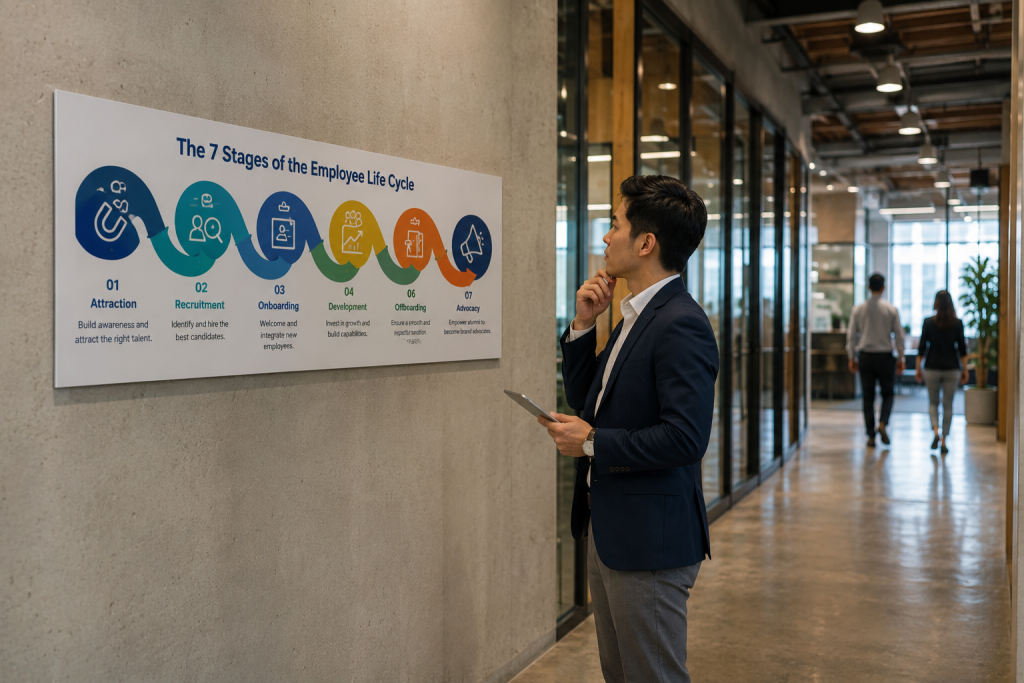
The employee life cycle is the full arc of someone’s time with your company, from the first time they hear your name to the day they leave and beyond. Seven stages, one continuous loop.
Most guides stop at naming those stages. This one goes further, because the stages themselves rarely break. What breaks are the handoffs between them, and that is where companies lose time, money, and capacity without ever seeing a line item for it.
A well-run life cycle compounds. Good hiring feeds good onboarding, which feeds retention, which lowers hiring costs, which frees budget and attention for the next stage. A broken one compounds too, just in the wrong direction, with every weak handoff adding cost to the stage after it. About 3.1 million U.S. workers quit their jobs in May 2026, according to the Bureau of Labor Statistics. Each of those exits restarts the life cycle at stage one and drags a real bill behind it: recruiting spend, lost productivity, and the months it takes a replacement to reach full speed.
If you run HR or operations, you already answer for headcount, efficiency, and ROI. Here is the part that stays hidden. Most of the loss is not one dramatic failure but routine, manual work no one has stopped to measure, which is exactly what makes it expensive. It never shows up as a crisis. It shows up as a recruiter spending Friday afternoon copying data between an applicant tracking system and payroll, or an HR generalist answering the same benefits question for the fortieth time. Multiply that across every stage and every week, and the lost hours add up to real headcount.
What Is the Employee Life Cycle?
The employee life cycle is the seven stages an employee moves through with an organization, from first awareness of the employer to their eventual departure and the relationship that follows. HR teams use it as a model to map and improve the entire employee experience, not just the stretch between onboarding and exit.
Think of it as the life cycle of an employee viewed from the company’s side of the table. The model gives HR, managers, and leadership a shared map of where people are, what they need at each point, and where the experience is quietly falling apart. It also reframes the job: onboarding is not where the employee experience begins, and offboarding is not where it ends. The reputation you build with people before they apply and after they leave shapes how much every future hire costs you.
The 7 Stages of the Employee Life Cycle
- Attraction
- Recruitment
- Onboarding
- Development
- Retention
- Offboarding
- Advocacy
The stages form a loop, not a straight line. Someone moves from a stranger who has never heard of you to a champion who sends you their best former colleagues, and strong exits and referrals feed back into the top of the funnel.
For each stage below, we cover what it is, what good looks like, and where companies lose time. That last part is where this guide goes past the standard model, because a stage can look fine on an org chart and still cost you weeks of productivity a year.
Stage 1: Attraction
Attraction is everything that shapes how potential candidates see you before they ever apply. Your employer brand, your reputation, your reviews, the careers page someone lands on at 11 p.m. It is the top of the funnel, and it is working whether you manage it or not.
The leak starts early. Weak or inconsistent employer branding makes recruiters work harder for every single applicant, and a thin careers presence shrinks the pool, so you pay to chase people a stronger brand would have pulled in for free.
Done well, attraction gives you a clear employer value proposition, consistent messaging everywhere a candidate checks, and an easy path from interested to applied. Here is the test. Could a strong candidate go from your job post to a submitted application in under five minutes on their phone? If not, the funnel is leaking before recruiting even starts.
One caveat on speed: a frictionless posting still has to be a compliant one. Colorado, New Jersey, and a growing list of other states require pay ranges in job postings, and the rules differ enough that one template applied across every market will put you out of compliance somewhere. Build the disclosure into the posting workflow instead of leaving it to whoever hits publish.
Stage 2: Recruitment
Recruitment is sourcing, screening, interviewing, and selecting the right person for an open role. It is the stage most people picture when they think of hiring, and it is where cost per hire lives.
The drain here is long time-to-fill, clunky applications that make good candidates give up, and recruiters hand-screening stacks of resumes that a first-pass filter could handle. SHRM’s most recent benchmarking puts average cost per hire at roughly $5,475 for non-executive roles, and most of that is time.
A strong version looks like a fast, mobile-friendly application, structured interviews that compare candidates fairly, and automation or AI handling first-pass screening so recruiters spend their hours on real finalists instead of the obvious nos. Structured interviews do double duty here, since consistent, job-related criteria are also your best defense if a hiring decision is ever challenged.
Stage 3: Onboarding
Onboarding runs from offer acceptance through a new hire’s first weeks, turning a signed contract into a productive team member. It sets the tone for everything after it.
Time bleeds out through manual paperwork, logins that are not ready on day one, systems that do not talk to each other, and unstructured first weeks that push back time-to-productivity. A rough start also hurts early retention, so the cost shows up twice.
Done right, onboarding runs on structured preboarding, automated workflows for forms and provisioning, and clear 30-60-90 day expectations. If you hire across state lines, the paperwork layer is also where jurisdiction-specific notices either get handled automatically or get missed one hire at a time.
Stage 4: Development
Development is how you grow people once they are in the door, through training, coaching, and internal mobility. It is the stage companies skip when they get busy, and the one they pay for later.
With no clear growth paths, managers improvise, high performers stall out, and roles get backfilled from outside instead of filled from within. Every external backfill restarts recruitment and onboarding for a role you could have filled internally.
Strong development means defined career paths, ongoing feedback instead of a once-a-year review, and internal mobility that keeps institutional knowledge in the building.
Stage 5: Retention
Retention is keeping your engaged, high-performing people and cutting avoidable turnover. It is where every earlier investment either pays off or walks out the door, and it carries the worst hidden math: the cost of losing someone good is rarely booked anywhere, even though it lands as lost billable hours, overloaded teammates, and a role you now have to fill twice.
The loss here is managers reacting to resignations instead of spotting the risk early. By the time someone hands in their notice, the decision is usually already made. The scale of the underlying problem is easy to underestimate: Gallup’s 2026 State of the Global Workplace report puts global employee engagement at 20% and estimates that low engagement costs the world economy about $10 trillion a year, close to 9% of global GDP.
The strong version runs on regular check-ins, real engagement data, competitive pay and recognition, and predictive signals that let managers act before a resignation lands. The cheapest retention move is usually the earliest one. A manager who notices a disengaged high performer in month three has options that a manager reading a resignation letter in month 12 does not.
Stage 6: Offboarding
Offboarding is managing a clean, respectful exit, whether someone leaves by choice or not. Done well, it protects the company and the relationship. Done badly, it creates risk and burns goodwill.
The leaks come from manual, checklist-driven exits that miss steps. Access that never gets revoked, knowledge that walks out undocumented, no honest exit feedback to learn from. Each miss becomes a problem someone else cleans up later.
This is also the stage where one standardized workflow can create exposure. Final pay deadlines, accrued leave payout rules, and required separation notices vary by state, so a single national offboarding checklist will be compliant in some jurisdictions and late in others. The workflow needs to branch by work location, not just by role.
A clean exit runs on a standardized process with those jurisdictional branches built in, structured knowledge capture before the person leaves, and exit interviews that feed improvements back upstream. A departing employee’s honest read on why they are leaving is some of the most useful data you will ever get about your own life cycle, and most companies throw it away.
Stage 7: Advocacy
Advocacy is the payoff stage, where former and current employees become ambassadors, references, and potential boomerang hires. It is the part of the loop most companies forget exists.
With no alumni relationship, goodwill evaporates the day someone leaves. Rehire potential disappears, and you go back to paying full price to attract strangers instead of welcoming back people who already know how you work.
At its best, advocacy is an alumni network, a clear boomerang rehire path, and current employees who refer friends and speak well of you. That closes the loop and feeds the next round of attraction. Boomerang hires are especially valuable because they need far less onboarding and already know your culture, which is why keeping the door open costs less than slamming it shut.
Where Companies Lose the Most Time Across the Life Cycle
The biggest leaks hide between the stages, in the manual, repetitive handoffs that connect them. The same data gets typed into three systems. Approvals get chased over email. The same employee questions get answered again and again by people who have better things to do.
Scale makes it worse. Past a few hundred people, the same stage often ends up run three different ways across teams and regions: one office onboards with a polished workflow, another still emails PDFs, and recruiting tracks candidates in a tool payroll cannot see. Each version works on its own, but the seams are where hours and data go missing, and the longer the drift runs the more expensive it gets to undo. In one engagement with a global professional services firm, EvolveUp recovered a meaningful share of billable capacity lost to duplicate administrative work by standardizing processes across APAC, EMEA, and U.S. operations and consolidating scattered employee records. Same workforce, same headcount, running on one clean system instead of five improvised ones. A positive employee experience connects these operational choices to retention, engagement, and day-to-day performance.
The fix is deliberately unglamorous. Map the manual work. Measure the time it eats. Then decide, stage by stage, what automation or AI can reasonably take off people’s plates. AI here is a tool that levels up your team, not one that replaces it: a resume filter that clears the first screening pass, a benefits bot that handles routine questions instead of routing every one to an HR generalist, an onboarding workflow that provisions accounts without a manual ticket.
The payoff is capacity, not a slide deck. If a manual task eats two hours a week across 40 people, that is more than four thousand hours a year, or roughly two full-time roles spent on work no customer ever sees. Reclaim even half and you have funded your next hire without adding headcount.
How to Turn the Employee Life Cycle Into an Advantage
Employee life cycle management only works when you run all seven stages as one connected system. Treat them as separate tasks and each stage starts optimizing for itself. Recruiting celebrates a fast hire that onboarding is not ready for, and onboarding hands off a new employee that no one owns for development.
Start with an audit. Walk each stage, define what good looks like, and find the handoffs where data gets re-entered or dropped. Then instrument the life cycle with HRIS and HCM systems that talk to each other, so a new hire’s details flow from recruitment into onboarding into payroll without anyone retyping them. Connected systems are the difference between a life cycle you can measure and one you can only guess at.
Then pick the one number that matters most at each stage and watch it. Time-to-fill for recruitment, time-to-productivity for onboarding, an engagement score for retention. Three or four honest metrics beat a dashboard with fifty that nobody reads.
Finally, build for where the company is going rather than where it sits today. If you are scaling, absorbing an acquisition, or heading toward an exit, the life cycle you design now has to hold up under that future. A merger or a system replacement is the rare moment when you can genuinely upgrade instead of consolidating onto the less-broken legacy system, and used well it resets the whole life cycle on infrastructure built for the next three to five years.
How to Choose HR Systems That Fit the Whole Life Cycle
The right HR system fits all seven stages and the direction your company is heading, not just the problem that sent you shopping. Most searches start in a scramble. Payroll breaks or a spreadsheet finally buckles, the team buys the tool that fixes today, and a year later it cannot handle recruitment or will not talk to onboarding. Now there are two systems and a fresh seam to manage.
A better order of operations is to gather requirements across every stage first, then judge each vendor against where the business will be after the next hiring surge or acquisition. That groundwork is exactly what lean internal teams have no time for, which is why EvolveUp runs the full path for clients, from mapping requirements and shortlisting vendors through structured selection and contract negotiation.
Before you sit through a single demo, write down what good looks like at each of the seven stages. A team that knows its own requirements picks a better system and pays less to get it.
Employee Life Cycle FAQ
What Are the 7 Stages of the Employee Life Cycle?
The seven stages are attraction, recruitment, onboarding, development, retention, offboarding, and advocacy. Some models compress these into five or six by combining steps, but the seven-stage version gives you the most complete view of the full employee experience.
What Is the Difference Between the Employee Life Cycle and the Employee Journey?
The life cycle is the organization’s model of the stages an employee passes through. The employee journey is that same path seen from the employee’s side, their lived experience of it. The two overlap heavily and are usually used together, one to design the system and one to understand how it feels.
How Do You Measure the Employee Life Cycle?
Stage by stage. Track time-to-fill for recruitment, time-to-productivity for onboarding, engagement scores and eNPS for retention, and turnover rate across the board. Reliable measurement depends on connected systems, which is why the data problem and the optimization problem are the same problem.
Who Owns the Employee Life Cycle in a Company?
Ownership is shared. HR designs and runs the life cycle, managers execute it day to day, and leadership is accountable for the business outcomes. In fast-scaling companies this is exactly where it breaks down, because everyone assumes someone else has the handoff covered.
Build a Life Cycle That Works as Hard as Your Team
The stages are only ever as strong as the handoffs between them. That is where time is won or lost, and where a well-run life cycle turns into a competitive advantage.
Finding those leaks and reclaiming the capacity trapped in them is the core of EvolveUp’s workforce optimization work, from mapping the manual handoffs to putting the right connected systems and AI-enabled tools in place. Schedule a consultation to audit your full employee life cycle and tighten the handoffs that cost you the most.