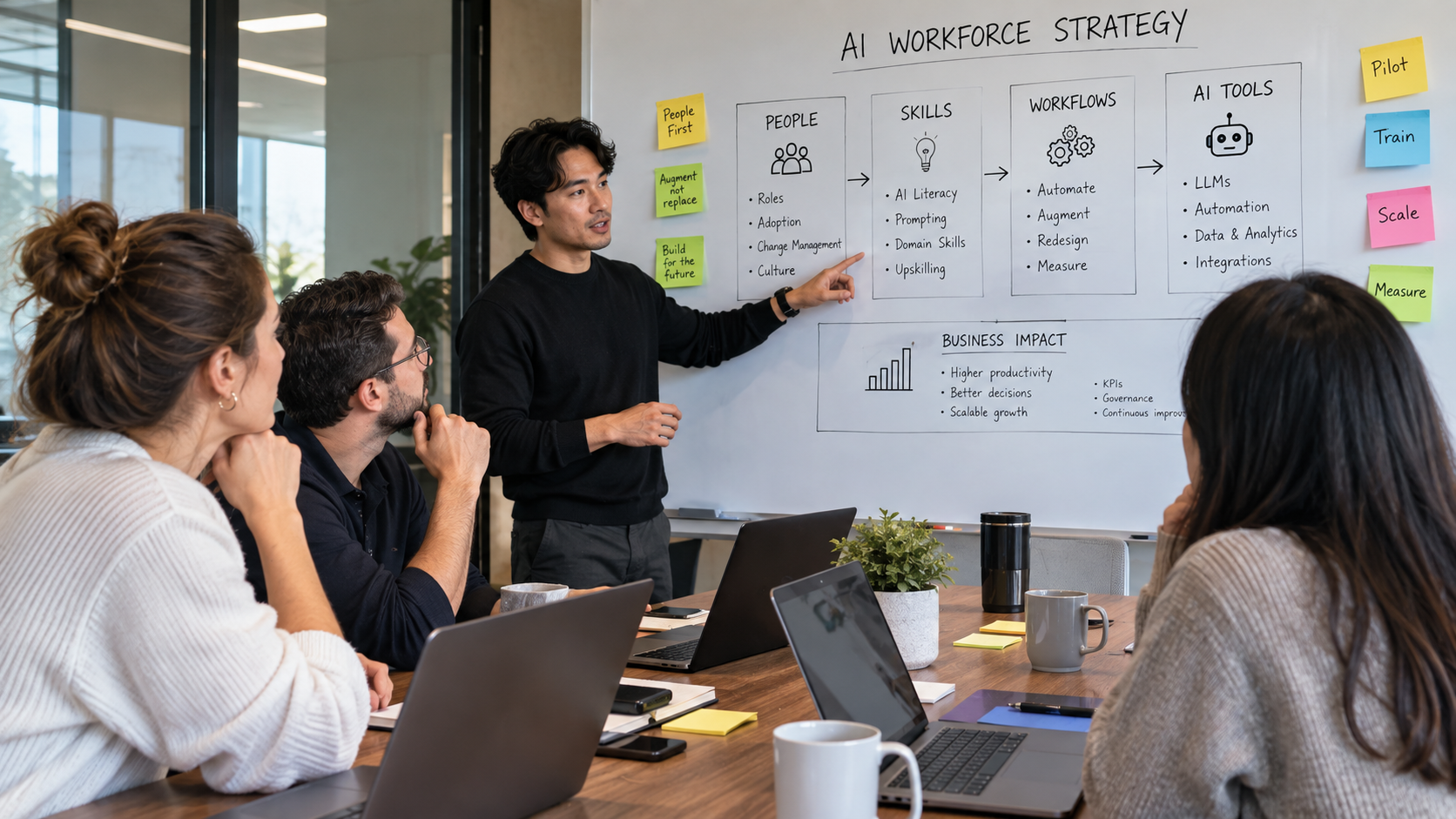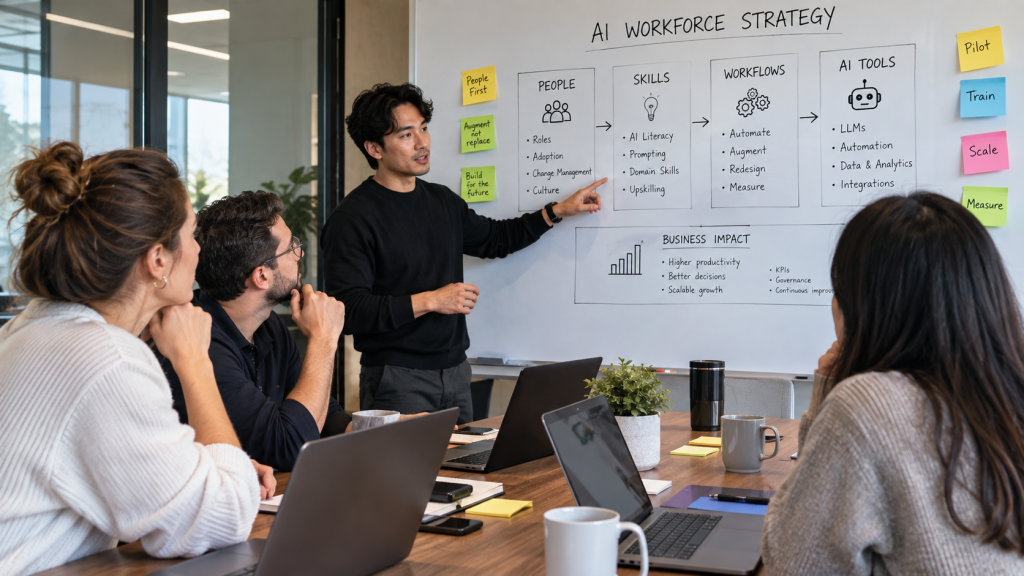
An AI workforce strategy is a practical plan for deciding where AI can help and how roles and workflows should change. It defines the skills employees need and sets rules for governing and measuring the work. The strategy gives technology a real operating context, so teams can remove manual work without treating people as disposable.
This guide gives HR, operations, and business leaders a six-step method to map work, prepare employees, increase adoption, and connect AI spending to workforce outcomes. The AI talent strategy has a simple goal. Help people spend less time on administration and more time on valuable work.
What Is an AI Workforce Strategy?
An AI workforce strategy connects business goals with task design, skills, workforce technology, governance, and adoption. It sets boundaries for routine work that AI can handle and decisions that AI can support. It keeps work that needs human judgment firmly in human hands.
Think of it as the plan around the platform. Buying software will not repair a murky approval process, unreliable data, weak ownership, or employee distrust. A one-time training course will not repair them either.
The strategy gives every group a clear part to play before implementation begins. HR plans skill and role changes, and operations repairs any broken handoffs. IT defines data and security requirements.
Finance connects the work to capacity, utilization, service quality, and EBITDA. Employees get a direct explanation of how AI will affect their daily work. This shared context supports human-AI collaboration and keeps implementation decisions tied to the operating model.
Why Your Workforce Strategy Should Come Before New AI Tools
Tool-first projects tend to multiply. One team buys a writing assistant, another tests a recruiting bot, and a third automates reports. The result can be disconnected pilots, inconsistent data, unclear ownership, and a dashboard that mistakes logins for progress.
Start with the operating need. If client delivery is slow, find the wait time, rework, and approvals that hold it up. If utilization is the problem, identify administrative tasks that consume billable capacity.
Evaluate technology against those constraints. A promising tool still needs a clear workflow, reliable data, an accountable owner, and a business result worth measuring.
At EvolveUp, we use this task-first discipline in our workforce optimization work. We map the work, measure the time involved, and separate process problems from technology needs before recommending a platform. This keeps the business case tied to useful outcomes such as time reclaimed, faster decisions, cleaner data, and room to grow without unnecessary headcount.
For PE-backed professional services firms, a practical AI operating model connects AI decisions to billable hours, capacity, EBITDA, and the three-to-five-year direction of the business. That context matters when leaders are preparing to scale, acquire, or exit.
Preparation lowers implementation risk. Leaders can agree on approved uses, data requirements, decision rights, and manager responsibilities before asking employees to work differently. The platform then supports an operating model people understand.
How to Build an AI Workforce Strategy That Prepares People
Workforce planning with AI agents should follow a repeatable sequence, but the steps may overlap. Each step still needs an owner, evidence, and a decision before the organization scales. Keep the work concrete and tie every decision to an operating need.
1. Tie AI Goals to Business and Workforce Outcomes
Begin with the result leadership needs. That might mean faster delivery, more billable capacity, better forecasting, cleaner employee data, or fewer manual handoffs. A goal such as “use more AI” measures activity and gives a weak pilot nowhere useful to go.
Capture the following baseline measures before launch.
- Cycle time
- Error rate
- Rework
- Utilization
- Employee effort
- Service quality
Have finance, HR, operations, IT, and business leaders agree on scope, guardrails, decision rights, and success measures. This makes the use of AI in workforce planning a business decision. It gives leaders a sound basis for stopping a pilot that produces little value, no matter how impressive the demo looks. The right workforce management solutions support that decision instead of defining it.
2. Map Work at the Task and Workflow Level
Job titles are too broad for sound AI decisions. Use skills mapping and break work into tasks, handoffs, exceptions, wait time, rework, systems, and data dependencies. Look closely at repeatable activity that drains time without demanding much context or judgment.
The details shift by persona. Recruiters screen resumes and coordinate interviews. HR teams field recurring benefits questions.
Salespeople rebuild information before client calls. Frontline managers chase approvals through email. Each workflow carries different needs and risks.
Concrete use cases can include resume matching for recruiters, benefits bots for employees, communication drafting for HR staff, and better account preparation for salespeople. Each use case should solve a measured workflow problem.
A workflow view shows where practical AI in HR or operations could help. The same view exposes problems a new tool cannot solve, including duplicate approvals, unclear ownership, and unreliable source data. Put those issues on the roadmap too.
Does AI Workforce Optimization Mean Replacing Employees?
AI workforce optimization does not have to mean replacing employees. It can remove routine work so people have more capacity for judgment, client service, and revenue-producing tasks.
At EvolveUp, we approach AI this way. We map manual work by persona, measure the time it consumes, and identify tasks technology can handle without taking accountability away from people. This gives leaders a clearer basis for redesigning work before they make headcount decisions. That is workforce transformation at task level: redesigning work around capacity, accountability, and better outcomes.
3. Decide What AI Should Automate, Augment, or Leave Human-Led
Classify each task by repeatability, risk, data quality, consequence, and need for empathy or judgment. Stable, rules-based work may suit automation. Predictive workforce analytics can support complex work by organizing information, surfacing patterns, or drafting a starting point for review.
Some decisions need human context and accountability. Employee relations, sensitive performance decisions, unusual client situations, and high-impact exceptions belong in that group. Write the human review step into the workflow and make it explicit.
Task-and-skill research helps leaders assess how AI may change parts of a job without labeling an entire role automatable. Leaders can redesign routine tasks and protect the judgment and interpersonal skills that create trust.
4. Redesign Roles, Ownership, and Governance
Role expectations must catch up with task changes. Update outcomes, responsibilities, handoffs, escalation paths, and manager expectations before discussing headcount. People need to know what good performance looks like when AI handles part of a process. When responsibilities and decision rights are unclear, organizational design consulting can help clarify the operating structure.
Assign clear accountability for each use case.
- Data quality
- Model oversight
- Security and vendor performance
- Employee feedback
- Incident response
Sensitive employee data and high-impact decisions need tighter review than a low-risk drafting assistant.
The NIST AI framework offers a practical foundation for incorporating trustworthiness into the design, use, and evaluation of AI systems. Use it to shape approved-use documentation, monitoring, accountability, and escalation. Responsible AI governance built into the workflow makes expectations clear before launch.
5. Build Persona-Based Training and Change Adoption
A generic AI course may raise awareness, but it will not prepare people for actual work. Recruiters, HR staff, employees, salespeople, and managers need role-specific examples and practice. They need judgment standards and escalation rules tied to the workflows they will use.
Start with baseline literacy. The AI Literacy Framework covers foundational concepts, direct tool use, effective prompting, output evaluation, and responsible use. Then move into hands-on practice with the systems, data, and situations each persona will face.
An AI upskilling strategy should use realistic scenarios, approved data, and examples of weak outputs. This gives employees a concrete way to compare a flawed result with the standard the business expects.
Training alone will not carry the change. Managers need coaching, and employees need a safe place to test the process. Leaders must explain what will change, what will stay the same, and how performance will be assessed.
Good change management consulting makes that conversation concrete enough to trust. Effective change management for AI adoption gives employees a way to practice, ask questions, and flag problems before the workflow expands.
When Does an AI Workforce Strategy Need Outside Support?
Outside support makes sense when an AI workforce strategy spans several systems, business units, or regions and the internal team cannot own the work beside daily operations.
EvolveUp assembles a project team around the skills each engagement needs, from process analysis and vendor selection through implementation and adoption. This gives leaders one path from the operating problem to a working process, with internal owners involved at every decision. For a broader HR transformation, this model keeps process, technology, and adoption decisions connected.
6. Pilot, Measure, and Scale
Pick a bounded workflow with clear inputs, manageable risk, usable data, and a visible operational problem. A benefits-question workflow, candidate scheduling process, or recurring report is easier to test. An end-to-end function packed with exceptions is harder to evaluate.
Track quality and adoption beside time and cost.
- Workflow use by persona
- Output quality
- Human override frequency
- Downstream improvements
- Employee confidence and manager support
Avoided tools do not create lasting capacity. Check whether people follow the workflow, outputs meet the required standard, and downstream work improves.
Scale after the workflow holds up under normal pressure and the gains persist. HR technology consulting can help when a pilot uncovers integration, vendor, migration, or platform issues the internal team cannot resolve alone. Evidence should lead AI workforce planning and scenario planning for the next implementation phase.
Which Skills Do Employees Need to Work With AI?
Most employees do not need to become machine-learning specialists. They need basic AI literacy, fluency with approved tools, and enough judgment to spot an output that is incomplete, risky, or wrong.
The Future of Jobs report found that 63% of surveyed employers viewed skill gaps as a barrier to business change, and 85% expected to prioritize upskilling through 2030. Skills belong in the operating plan from the start.
Build capability in three layers.
- All employees need core concepts, data rules, output checks, and escalation paths
- Role-specific users need practice with live workflows
- A smaller specialist group needs deeper expertise in data, model evaluation, integration, security, or vendor management
Human skills matter more as routine execution speeds up. Problem framing, clear communication, empathy, collaboration, and professional judgment shape the quality of AI-supported work. Close workforce AI readiness skill gaps through training, job redesign, internal mobility, targeted hiring, and specialist support based on urgency and long-term ownership.
How Do You Address Employee Concerns and Earn Adoption?
Name employee concerns directly.
- Job security
- Surveillance and data use
- Fairness and accountability
- Changing performance expectations
- Confidence using new tools
Silence leaves room for the bleakest explanation. Explain the business problem and use-case boundaries first. Show which tasks AI will support, which decisions remain human, what data the system will use, and how people will review outputs.
Give employees a way to challenge the design and report problems without being dismissed as resistant. People closest to the work know where exceptions hide. They can point to wasted steps, risky shortcuts, and approvals nobody needs.
Bring employees into workflow mapping, pilot design, testing, and retrospectives. Their input can reveal practical risks and useful opportunities that a leadership-only design misses.
Managers are the daily adoption channel. Equip them to coach the process, answer questions, and notice unfair shifts in workload or performance expectations. EvolveUp’s position stays clear throughout the rollout. AI should level up employees by removing manual work and making room for client service, judgment, problem-solving, and revenue-generating activity. Employee experience consulting can help leaders align communication, coaching, and employee feedback with the redesigned work.
How Should You Measure AI Workforce Readiness and ROI?
Readiness asks whether the organization can support the change. Track these signals.
- Clear workflows and accountable owners
- Reliable data and working integrations
- Completed role-based training
- Confident employees and prepared managers
- Compliance with approved uses
Enthusiasm cannot compensate for weak data or missing accountability.
ROI asks what the change produces. Track these measures.
- Time reclaimed and cycle time
- Error rates and throughput
- Service quality and cost to serve
- Adoption by persona
- Capacity, utilization, revenue visibility, and EBITDA
Saved minutes are not realized value on their own. Leaders must decide where reclaimed capacity will go, perhaps into client work, faster hiring, better manager coaching, cleaner reporting, or fewer delays. Put that conversion in the business case.
Review results at defined checkpoints. Compare the pilot with the baseline, examine exceptions and overrides, and ask employees what helps or gets in the way. Confirm that governance still works.
AI workforce readiness changes with roles, data, tools, and business priorities. Treat it as an ongoing management discipline.
Common Mistakes That Derail AI Workforce Transformation
Buying technology before mapping the work puts the tool ahead of the problem. A polished platform can automate the wrong step, depend on poor data, or add another disconnected system. Start with the process and business outcome.
Treating every employee the same creates a different problem. Generic training, communication, and access rules miss the needs of recruiters, HR staff, salespeople, managers, and employees. Persona-based design makes the change easier to use and govern.
Scaling too soon is another common failure. A pilot is not ready only because the demo worked or license use rose. Quality, adoption, manager support, data, and accountability should remain steady through a busy week, awkward exceptions, and real deadlines.
Hidden employee concerns and shallow metrics can sink a promising deployment. High login counts may coexist with more rework. A credible AI adoption strategy for employees combines plain communication, practical training, worker feedback, responsible governance, and results the business can see.
Build an AI Workforce Strategy for Where Your Business Is Going
A strong AI workforce strategy prepares people and operating systems for the next stage of the business. It starts with outcomes, maps work at task level, builds the skills each persona needs, earns employee trust, and expands only when the evidence supports the move.
The roadmap should address current pain and the next stage of growth, including new systems, acquisitions, or an exit. At EvolveUp, we help leaders find workforce friction, map AI-ready workflows, and build adoption around where the business is going. Schedule a consultation to identify one practical starting point and define the workforce, technology, and adoption decisions needed to move it forward.